OpenVLA-OFT · 7BLIBERO-Spatial & LIBERO-GoalPreregistered

Gated Recursive Self-Improvement for Robot Policies From self-practice to program adaptation

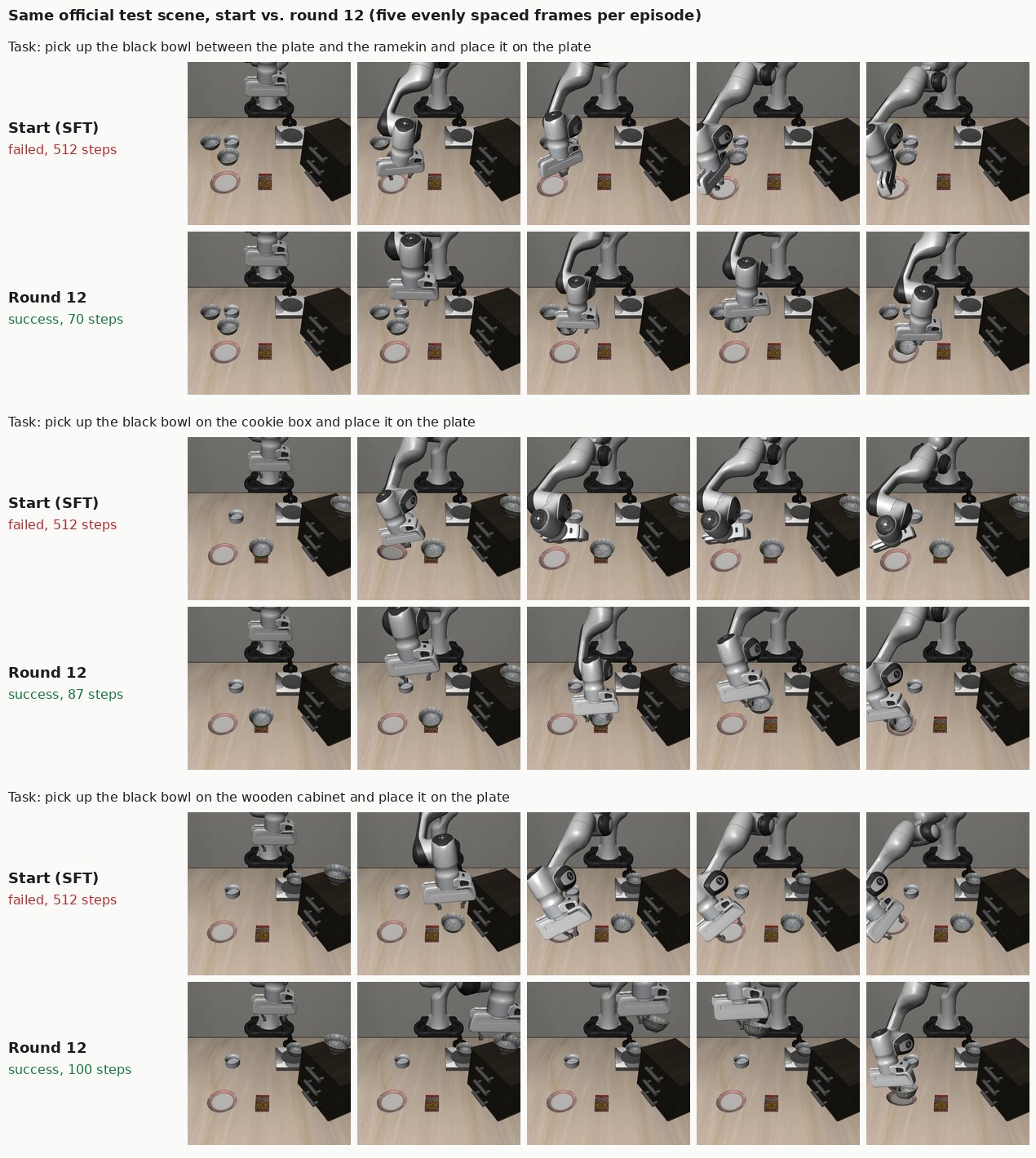
Left: the starting policy   Right: the policy kept after 12 rounds Five official LIBERO-Spatial test scenes · greedy actions · 3× speed
+7.30 to +8.67pp
recursion vs frozen data, all CIs > 0

Collecting each round's data with the newest kept policy, against the same loop fed by the frozen initial policy. Twelve GRPO rounds, both suites, both tests.

+8.4 to +15.5pp
gate vs accept-all, 6 rounds

With a behaviour-cloning program that degrades the policy, the gate keeps success this far above accepting every update.

+2.2pp
95% CI [+0.86, +3.53]

Above a tuned GRPO baseline on fresh LIBERO-Goal scenes after six rounds, at about half its GPU-hours (118 vs 230, tuning included).

Abstract

We study how a robot policy can keep improving over many rounds of practice with simulator success feedback, without costly new demonstrations. Existing self-training methods can improve policies from such feedback, but repeated practice alone does not guarantee continued progress. Each retained policy generates the next round's experience, while the training program determines how that experience is used; poor updates and ineffective programs can therefore hinder subsequent learning. We present a gated recursive self-improvement (RSI) framework for robot policies, in which a language model adapts the training program from the records of past rounds and a gate retains a candidate policy with its program only if it matches or beats its parent on the same validation placements, redrawn each round. We apply RSI to a 7B OpenVLA-OFT policy on LIBERO-Goal and LIBERO-Spatial, measuring success on 1,000 newly sampled placements per suite that training and selection never use. With a working GRPO program kept fixed, RSI raises success over twelve rounds and ends 7.3 to 8.6 points above the same loop with data from the frozen initial policy. With a behaviour-cloning program that degrades the policy when every update is accepted, the gate keeps success 8.4 to 15.5 points above the ungated loop after six rounds, and program adaptation raises success further. Starting from the same program, RSI also exceeds a tuned GRPO baseline on LIBERO-Goal by 2.2 points after six rounds, using about half the GPU-hours spent tuning and training that baseline. These results suggest judging self-training both by the policy it retains and by whether its training program can still produce useful updates.
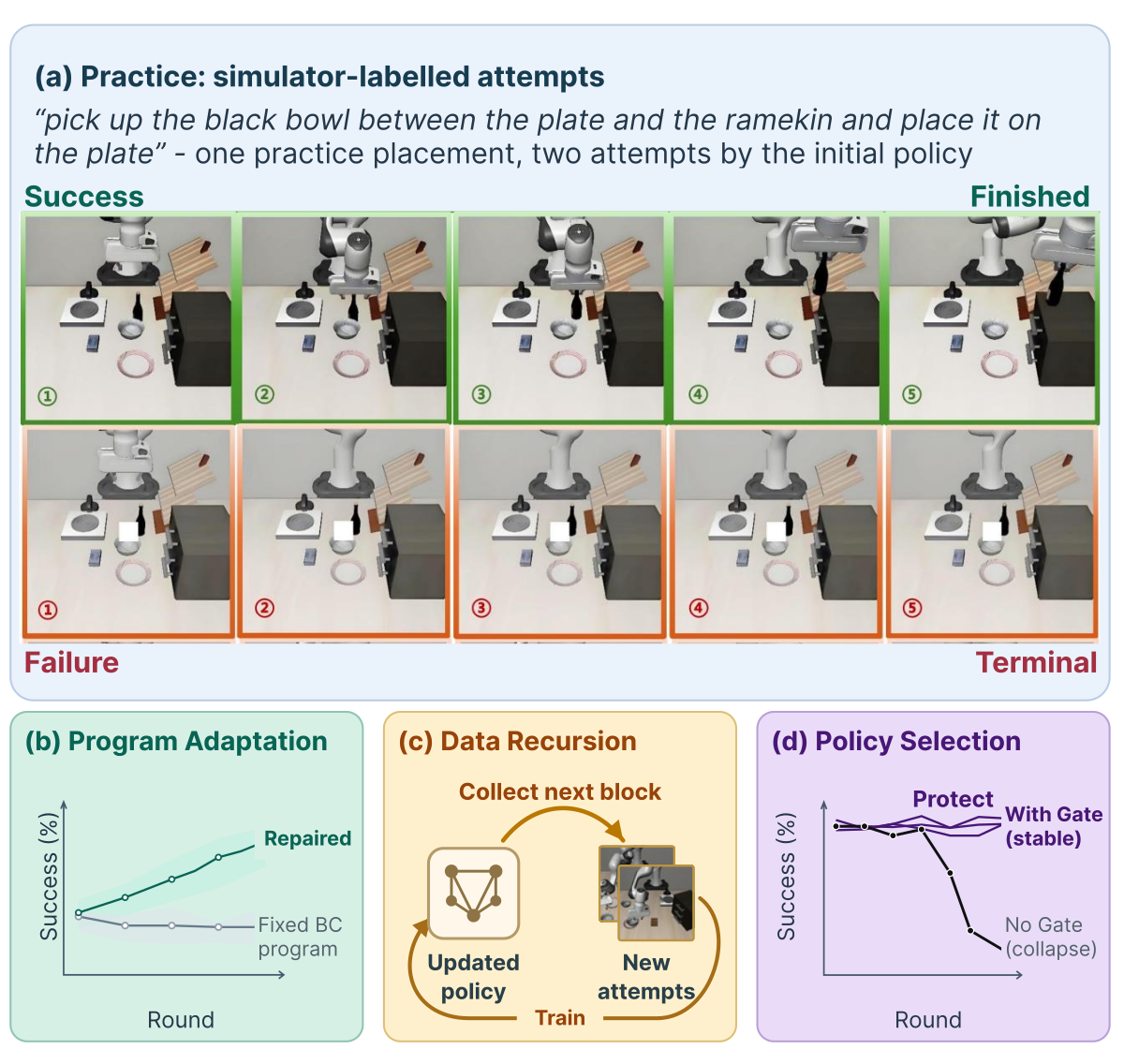
Overview: (a) two practice attempts by the initial policy on the same LIBERO-Spatial placement, one labelled success and one failure; (b) program adaptation repairs a fixed BC program; (c) data recursion, where the updated policy collects the next block; (d) policy selection, where the gate keeps success stable while accepting every update collapses.
Recursive self-improvement for a robot policy. (a) Practice: initial policy rollouts on LIBERO-Spatial, labelled as success or failure by the simulator. (b) Program adaptation: meta-level repair improves an ineffective BC policy on LIBERO-Goal. (c) Data recursion: updating the rollout policy improves success rates over using the frozen initial policy. (d) Policy selection: the gate prevents harmful updates, while accepting all updates causes performance to collapse from 58.5% to 7%.

How the loop works

The policy starts from supervised fine-tuning on one demonstration per task, which gives about 60% success (LIBERO provides 50 per task). After that it receives no new demonstrations. Each round it practises on sampled scenes, the simulator labels every attempt as success or failure, and a training program turns those attempts into a candidate update.

Data recursion

The newest policy collects the next data

A round runs three training blocks with GRPO or BC. The policy updated in one block generates the data for the next, so what it can already do shapes what it learns.

Policy selection

A gate decides which update to keep

Candidates are compared with their parent on the same validation placements, redrawn every round. The best candidate and its program are kept only if they match or beat the parent; otherwise the parent stays.

Program adaptation

A language model revises the training program

The meta layer reads the records of past rounds and proposes alternative programs, which are trained alongside the retained one and face the same gate.

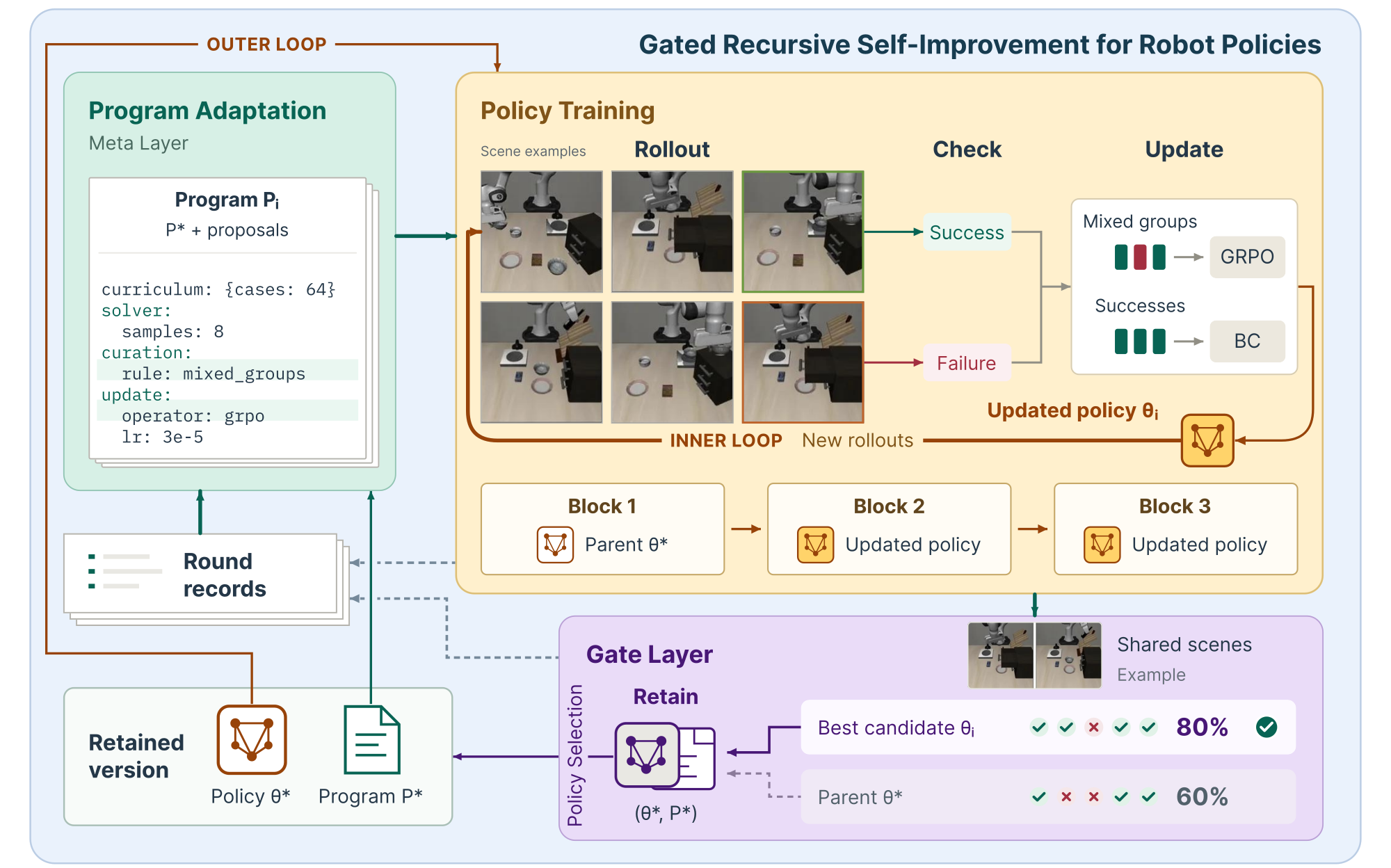
Framework diagram: an outer loop with program adaptation from round records; an inner loop of rollout, success check and GRPO or BC update over three blocks; a gate layer that retains the best candidate and its program only if it beats the parent on shared scenes.
Gated recursive self-improvement for robot policies. The inner loop performs three training blocks, updating the policy from verifier-labelled rollouts using GRPO or BC. The updated policy generates each subsequent block's data. A gate compares candidates with their parent on paired held-out placements, retaining the best candidate and its program if it matches or exceeds the parent's success rate; otherwise, the parent pair is kept. The meta layer uses round records to propose alternatives alongside the retained program.

Findings

The comparisons were preregistered before the runs. Effects are success-rate differences in percentage points with 95% confidence intervals from a seed-averaged paired bootstrap. Two tests stay outside the loop: the benchmark's 500 official states and 1,000 fresh scenes per suite, sampled from a range nothing else uses.

Data recursion

Collecting with the newest policy beats collecting with a frozen one

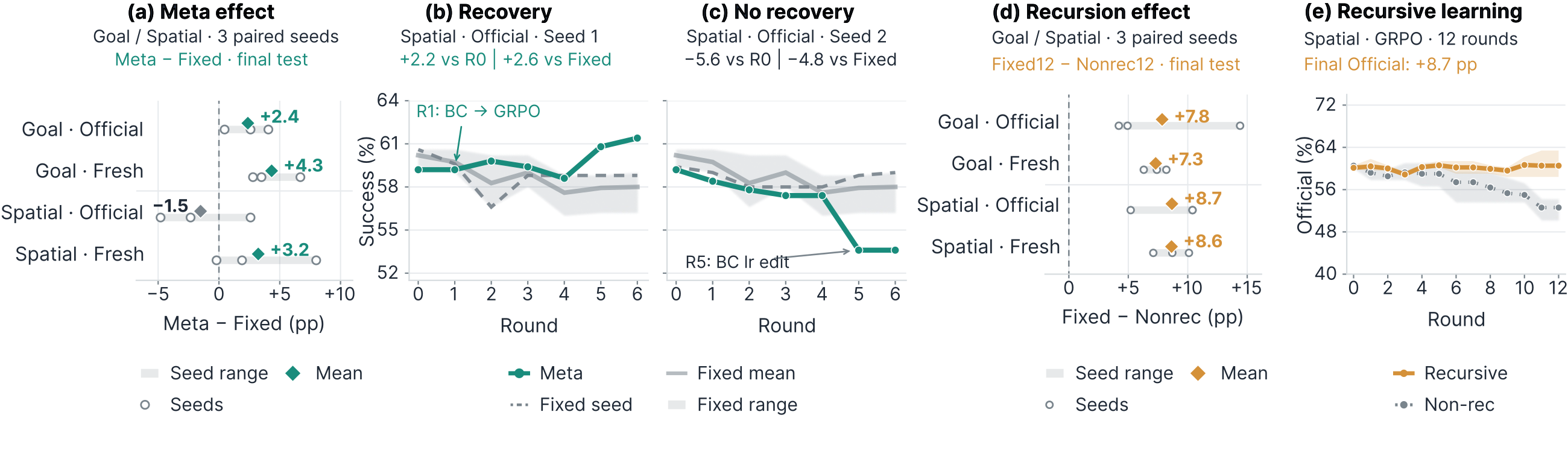
Recursion outperforms the non-recursive control by +7.30 to +8.67 pp across both suites and both tests, with every paired 95% CI above zero. Relative to the start it holds official-state success (+0.40 to +0.93 pp) and raises fresh-scene success by +3.54 pp on Goal and +7.38 pp on Spatial. The non-recursive control loses ground in all four settings.

Five panels: (a) meta level minus fixed on the final tests; (b, c) official success by round on Spatial for seeds 1 and 2; (d) fixed minus non-recursive after twelve rounds; (e) recursive versus non-recursive learning on Spatial over twelve rounds.
Scroll sideways to see all five panels.
Program adaptation and data recursion. (a) Meta level minus fixed on the final tests, seeds 1–3. (b, c) Official success by round on Spatial, seeds 1 and 2, against fixed. (d) fixed minus nonrec after twelve rounds. (e) Spatial, GRPO: recursive versus non-recursive data generation.
Program adaptation

Revising the program raises fresh-scene success on both suites

Against the same loop with its program fixed, adaptation adds +4.33 pp on fresh Goal scenes and +3.23 pp on fresh Spatial scenes (seeds 1–3, figure below). The comparison includes extra search: adaptation evaluates twice as many candidates per round. In panel (b) above, the meta level switches seed 1 from BC to GRPO in round 1.

Policy selection

The gate stops a weak program from erasing what the policy knows

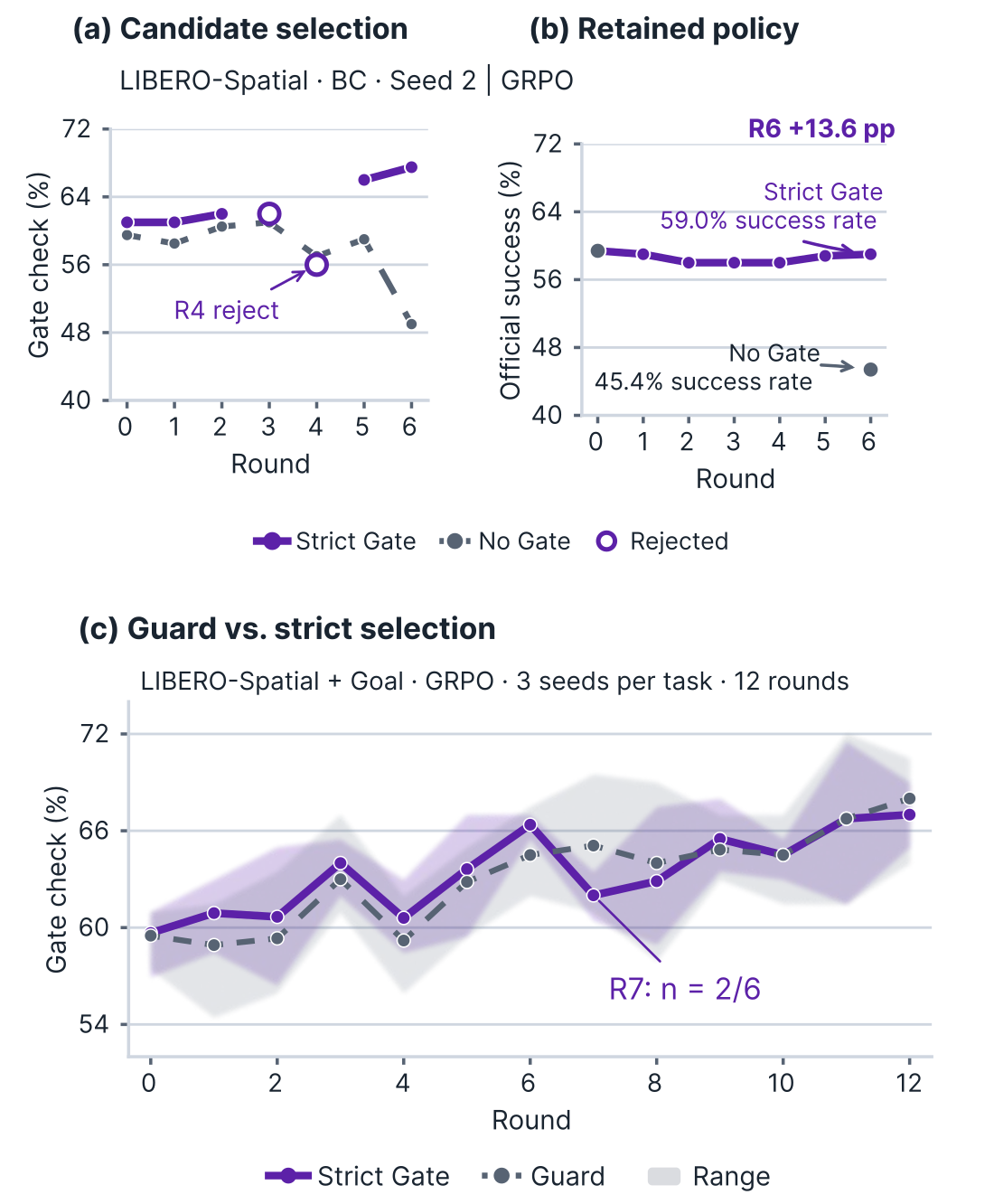
On Spatial seed 2 the gated loop rejects the harmful updates at rounds 3 and 4 and keeps 59.0% official success after six rounds, while ungated training falls to 45.4%. Across three seeds the mean official decline is 2.20 pp with the gate and 13.80 pp without it. A relaxed guard that tolerates 5-point dips tracks strict selection closely over twelve GRPO rounds.

(a) Gate-check success of each candidate on LIBERO-Spatial, BC, seed 2, with the round-4 candidate rejected; (b) official success of the retained policy, 59.0% with the strict gate and 45.4% without; (c) strict gate versus relaxed guard over twelve GRPO rounds.
Policy selection. (a, b) Spatial, BC, seed 2: gate-check success of each candidate (open circles: rejected) and official success of the retained policy, with and without the gate. (c) Strict gate versus relaxed guard, twelve GRPO rounds, three seeds per suite.
Cost

The loop passes tuned RL early, counting RL's tuning

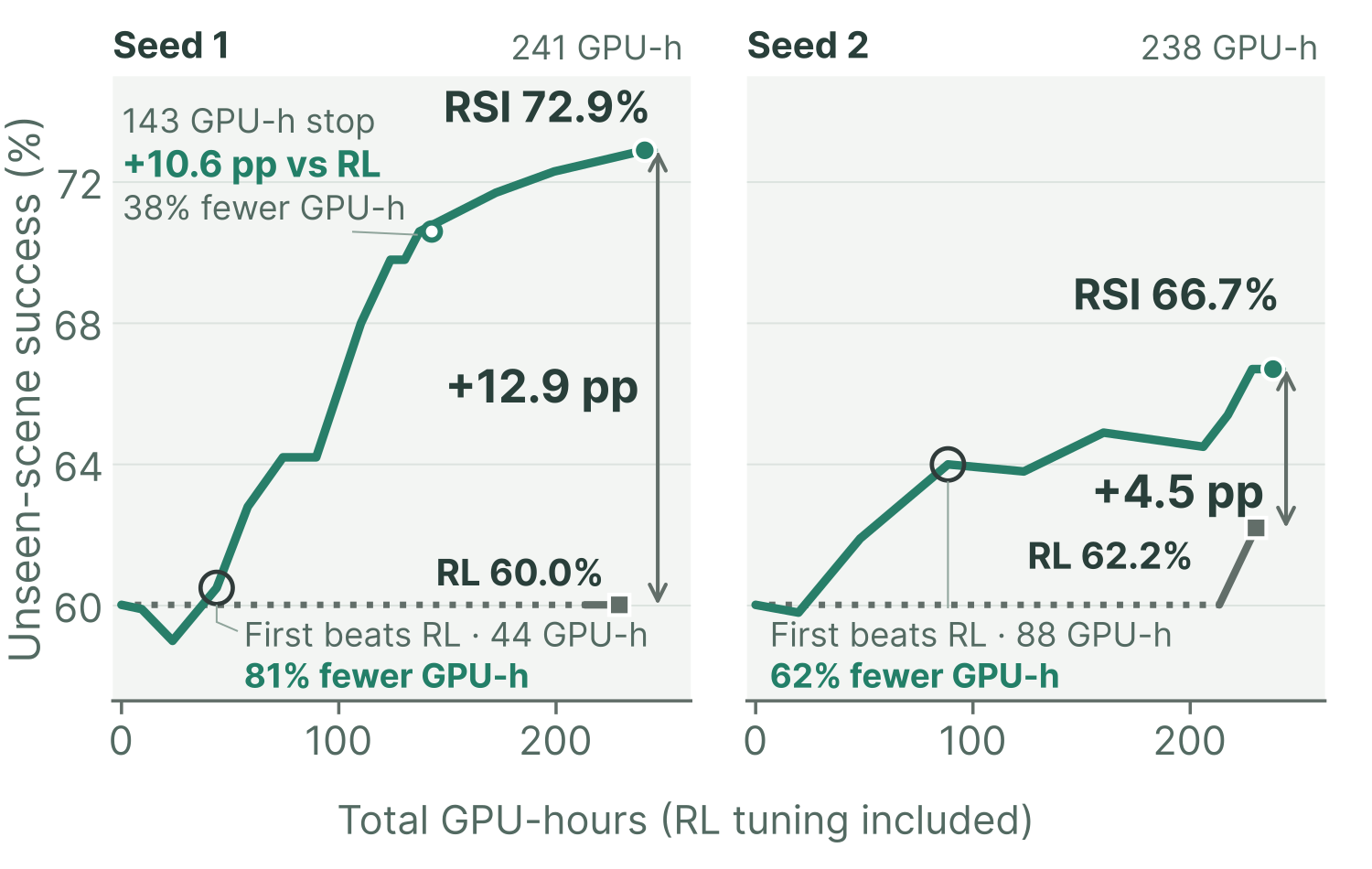
Choosing RL's configuration took 21 pilot runs (213.4 GPU-hours), so RL-18 costs 229.9 GPU-hours in total. The loop first beats it on fresh scenes after 44 GPU-hours on seed 1 and 88 on seed 2. After six rounds (118.1 GPU-hours, seeds 1–3) it is +2.20 pp [+0.86, +3.53] ahead. In the preregistered continuation (seeds 1 and 2) it finishes +7.6 pp [+5.6, +9.6] ahead using 190 GPU-hours against RL's 230.

Unseen-scene success against total GPU-hours for seeds 1 and 2: RSI reaches 72.9% and 66.7% against tuned RL at 60.0% and 62.2%, first beating RL after 44 and 88 GPU-hours.
Performance and compute cost, including RL tuning (LIBERO-Goal, 1,000 unseen scenes). RL spends 213 GPU-hours choosing its configuration, then trains 18 blocks. Rings: first version above RL.
Evaluation

Official states and fresh scenes can disagree

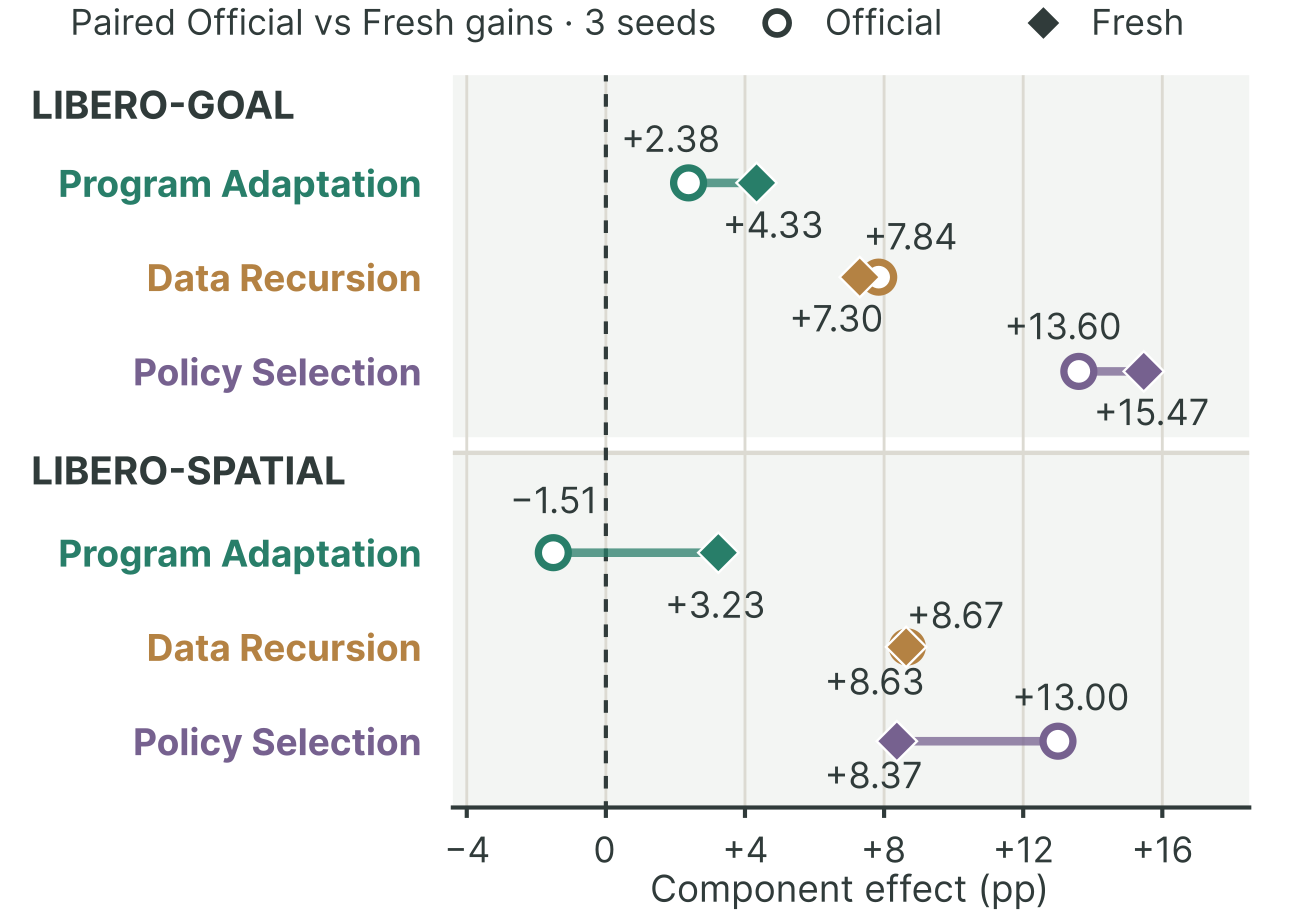
Program adaptation on Spatial reads −1.51 pp on the official states and +3.23 pp on fresh scenes. Reusing test states for training widens the gap: a released VLA-RL checkpoint trained on LIBERO-10's own test states gains an estimated +16.8 pp [+9.8, +23.4] from that reuse, about a fifth of its reported score.

Paired official versus fresh gains for program adaptation, data recursion and policy selection on LIBERO-Goal and LIBERO-Spatial.
Official versus fresh evaluation. Component effects (pp) on the official test states (open circles) and on 1,000 fresh placements (diamonds), seeds 1–3.

Rollouts before and after

Three of the five scenes in the video, with five evenly spaced frames per episode. Top of each pair: the starting policy, FAIL. Bottom: the policy kept at round 12 of a fixed-GRPO run, SUCCESS. On the 500 official states this pair went from failure to success in 41 states and the other way in 24, so the scenes were picked by hand to show behaviour. The success rates are the numbers above.

Frame strips for three LIBERO-Spatial scenes: the starting policy fails and the round-12 policy succeeds in each.

Setup at a glance

Policy
OpenVLA-OFT, 7B, action chunks of 8, initialised from SFT on one demonstration per task.
Suites
LIBERO-Spatial (ten pick-and-place tasks, different layouts of the same objects) and LIBERO-Goal (ten goal-conditioned tasks in one scene).
Feedback
Binary task success from the simulator. No new demonstrations.
Gate
200 greedy episodes per check, 20 placements per task, redrawn every round.
Tests
Official: the benchmark's 50 fixed states per task. Fresh: 1,000 placements, 100 per task, never used by training, gating or the meta level.
Compute
NVIDIA A800 80 GB GPUs; most runs use one GPU.